
At CTI, we are continually exploring ways to simplify operational workflows and improve access to critical business data. One of our latest prototype developments within PegaSys is an AI-driven reporting tool designed to make aviation reporting more accessible through natural language interaction.
Traditionally, operational reporting systems require users to have knowledge of SQL, database structures, and underlying schemas in order to retrieve meaningful data. This often means that ad hoc reporting requests need to be written or supported by technical teams, creating delays and limiting accessibility for non-technical users.
Our new PegaSys AI prototype aims to remove that barrier.
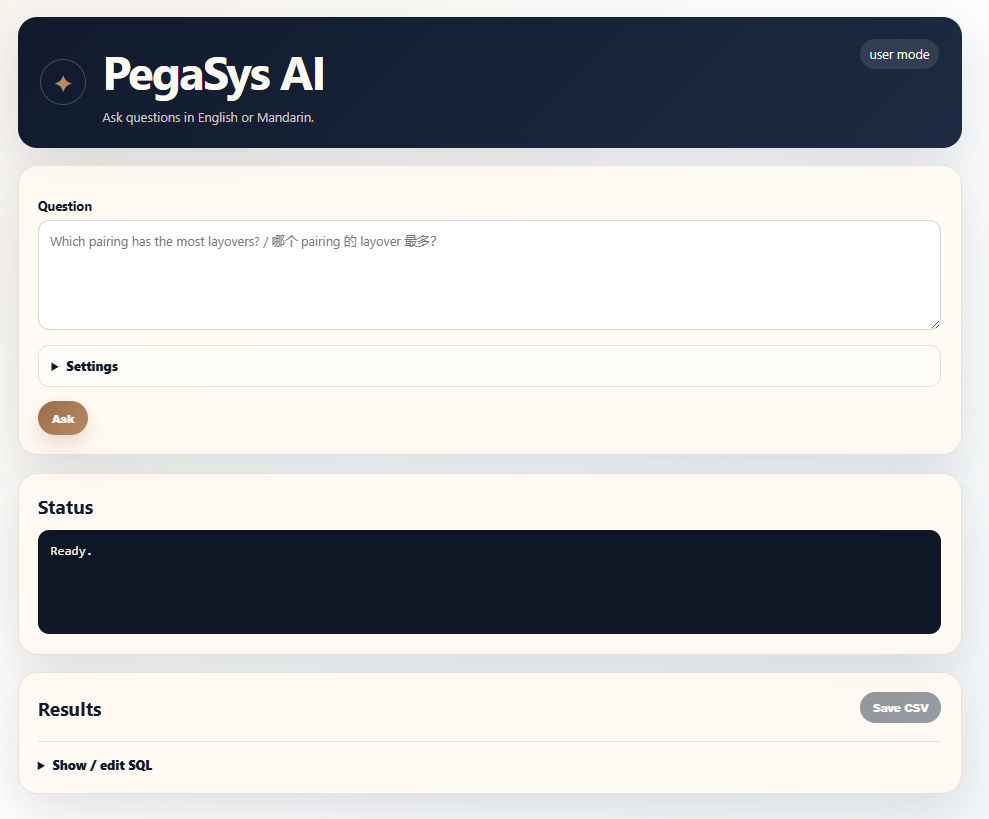
Using a Large Language Model (LLM) combined with a dedicated SQL AI and a schema-aware Knowledge Bundle, users can simply ask questions in natural language, in virtually any language, and have those requests translated into SQL queries against the PegaSys database.
The results can then be viewed directly within the interface or downloaded as CSV files for further analysis.
Making Reporting Accessible to Everyone
One of the most powerful aspects of this approach is that it enables users across the organisation to ask operational questions without needing to commission custom report development.
A CEO may ask a high-level financial or operational question, while an operations controller may ask something highly specific related to crew activity, allowances, or compliance deadlines.
Potential users include:
- Operations teams
- Planning teams
- Analysts
- Management and executives
This flexibility allows operational data to become far more accessible across the business.
Example Questions the AI Reporting Tool Can Answer
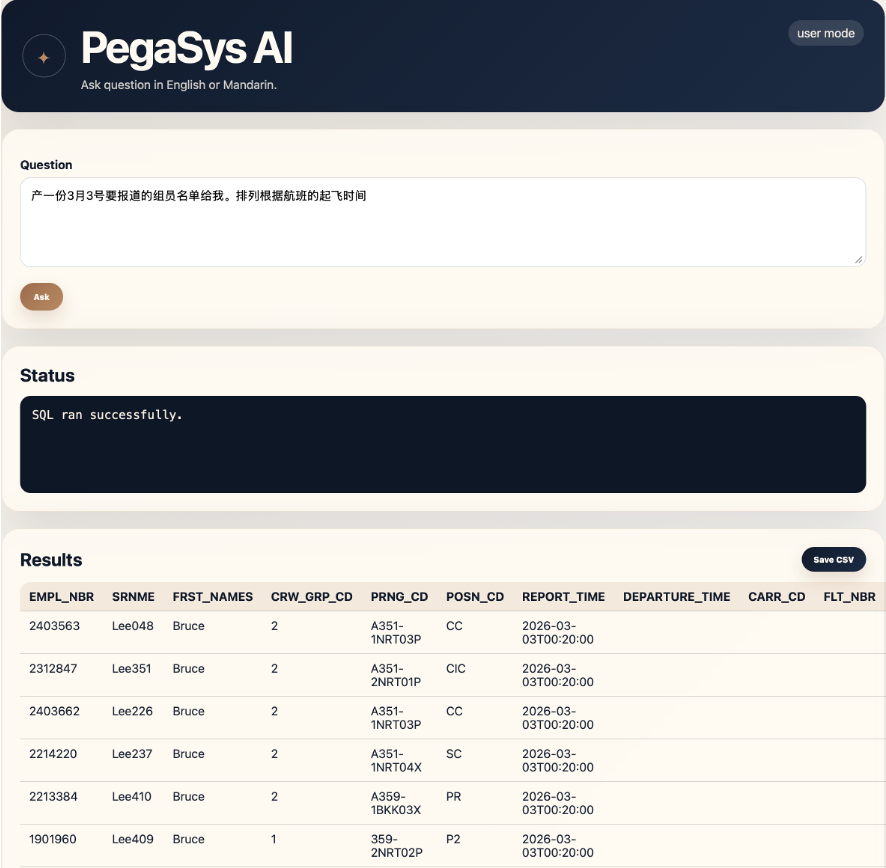
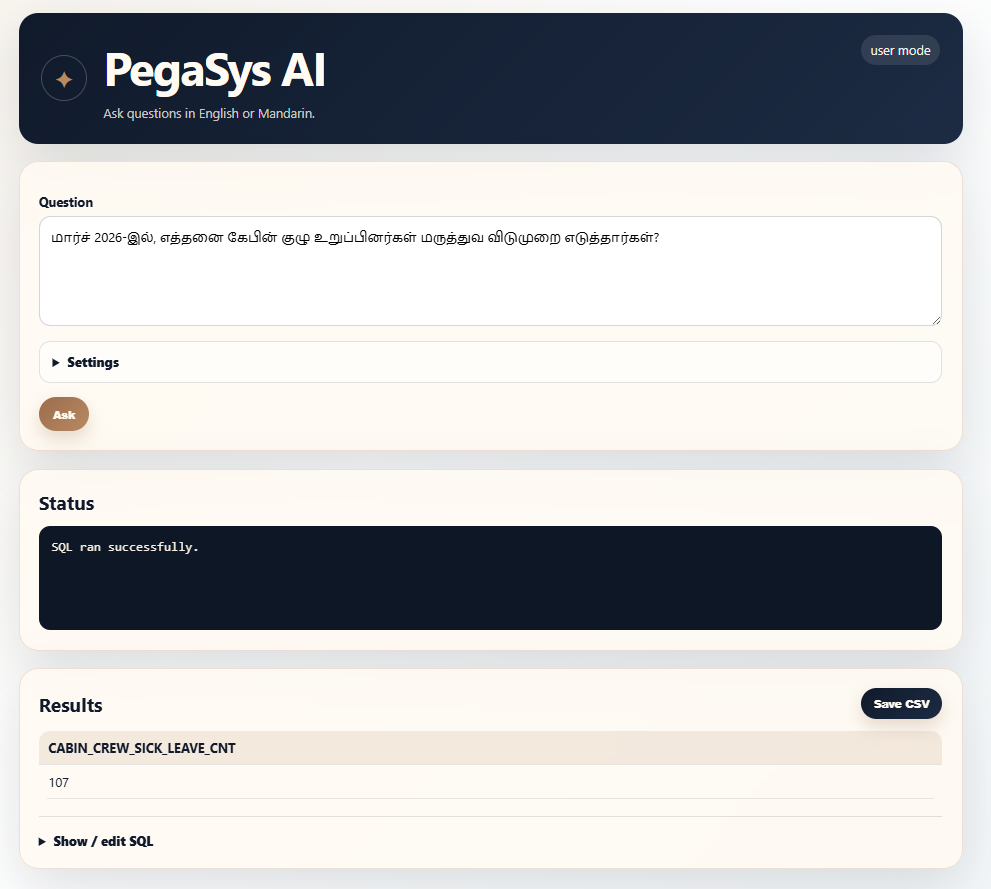
The prototype is already capable of responding to a wide range of operational and analytical queries in virtually any language, making reporting more accessible to users across different regions and teams.
Example questions include:
- “Give me the top ten crew for taking sick leave in March 2026”
- “Give me the top allowance earners by month for the past year”
- “How many captains have an SEP expiry in the next month?”
- “What is my allowance cost in April 2026?”
- “Which crew and how long was each crew sick in March 2026?”
These are the types of questions that would traditionally require manual SQL development or predefined reports.
How the System Works
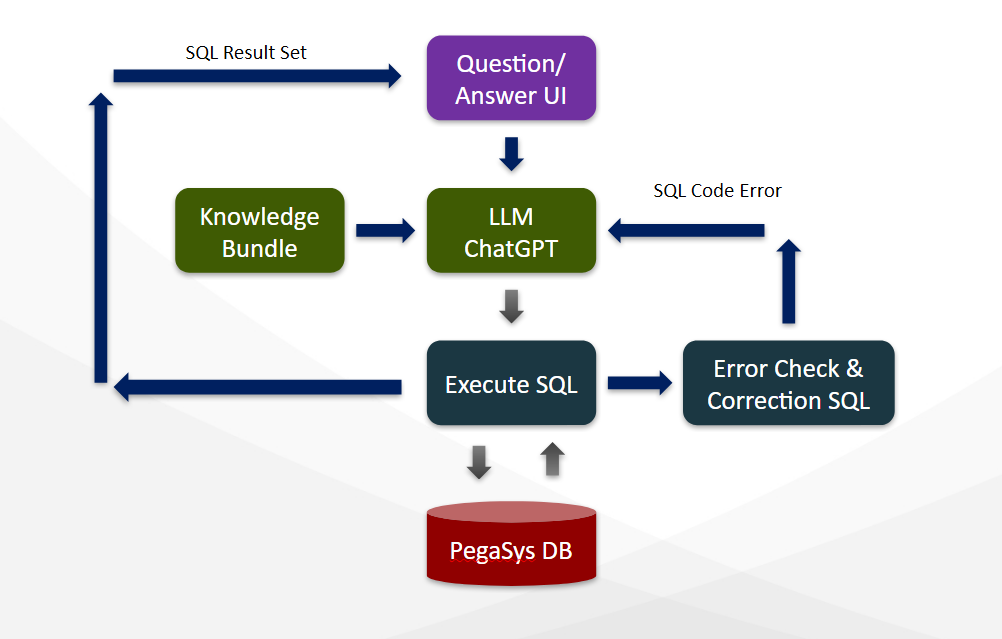
The reporting workflow combines multiple AI-assisted components:
- The user submits a question through a Question & Answer interface.
- The LLM interprets the request and generates SQL.
- A dedicated Knowledge Bundle provides schema awareness, including table relationships and appropriate joins.
- The SQL is executed against the PegaSys database.
- If the query encounters syntax or execution errors, the system automatically attempts to correct and retry the SQL.
- The resulting dataset is returned to the user.
The Knowledge Bundle plays a key role by helping guide the AI towards the correct schema relationships and query structures, reducing ambiguity and improving consistency.
Supporting Operational Investigations
While the prototype is already delivering promising results, AI-generated reporting should still be treated as an operational support tool rather than a fully autonomous decision-making system.
AI can occasionally misunderstand context or generate incorrect assumptions, particularly with highly specialised operational data. For this reason, the tool is designed to help users focus and accelerate follow-up investigations rather than replace validation processes entirely.
In many cases, the value comes from dramatically reducing the time required to explore operational questions and identify areas requiring deeper analysis.
Looking Ahead
As development continues, we are extending the AI’s understanding of operational terminology, schema relationships, and contextual reasoning to further improve the quality and relevance of generated queries.
We are also exploring infrastructure approaches such as dedicated reporting database replicas to ensure AI-driven ad hoc querying does not impact production system performance.
The long-term vision is to create a natural language reporting environment where operational users at every level of the organisation can interact with complex aviation data as easily as asking a question.
At CTI, we believe this represents an exciting step towards making operational intelligence more accessible, responsive, and scalable across the aviation industry.